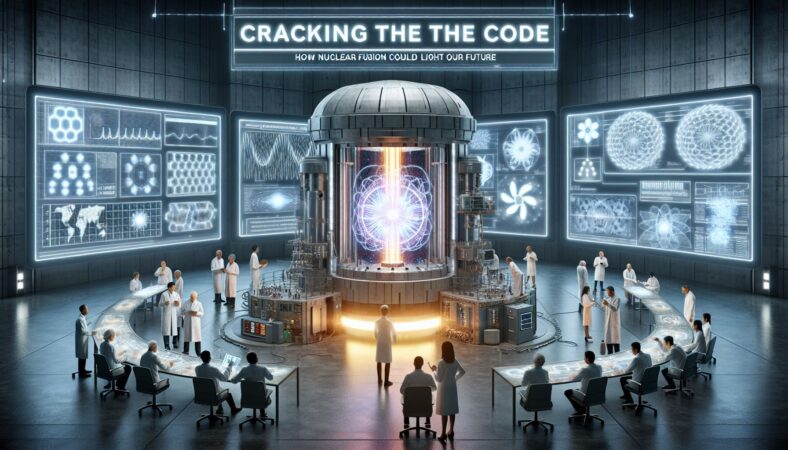
Most of us have probably daydreamed about a future powered by unlimited clean energy—perhaps while stuck in bumper-to-bumper traffic, wondering if next time you’d be better off cycling to work on an electric penny-farthing. Enter nuclear fusion: that mythical grail of tech breakthroughs, as elusive as my attempts to finally organize my digital clutter. But hold onto your hats, folks, because what was once the stuff of sci-fi legend now feels tantalizingly close to reality.
The Basics: What Even is Nuclear Fusion?
For those of you nodding politely while frantically Googling “nuclear fusion,” let’s break it down to the basics. Nuclear fusion is the process where two light atomic nuclei merge to form a heavier nucleus, releasing a boatload of energy. It’s the same cosmic fireworks that power our sun and every other star you see when you finally manage a break from your screens for some stargazing.
Unlike nuclear fission, which splits heavy atoms and is the stuff of traditional nuclear power plants, fusion doesn’t produce long-lived radioactive waste. That means no more worries about digging storage for hazardous leftovers that could outlive the entire cast of “Twilight” by thousands of years.
Current Developments: Baby Steps Towards a Fusion-Powered World
Now, lest you think we’re already living on the set of a futuristic series set in the year 3000, I must remind you that despite decade-spanning investments, nuclear fusion has been tantalizingly “just 30 years away” for what feels like forever. But wait! There’s been a flurry of progress lately that’s changing the fusion game.
Take, for example, the International Thermonuclear Experimental Reactor (ITER) in France. That’s your $25-billion behemoth where countries like China, the U.S., and much of the E.U. are pooling their scientific wizardry. If ITER’s massive doughnut-shaped chamber can achieve its goal in the next decade, it would prove that commercial nuclear fusion could be realistically achieved. Think of it as the world’s most ambitious bake-off, except it’s plasma getting cooked at temperatures hotter than the sun’s core.
Meanwhile, fusion startups like TAE Technologies and Commonwealth Fusion Systems are sprinting in parallel, betting on more compact and innovative magnetic confinement systems. With billions in funding from private backers, ranging from tech luminaries to starry-eyed venture capitalists, these companies are bringing startup hustle to an energy source that could save the planet. Not to mention, popping kneecaps seems like a legitimate form of protest for the climate-active tech crowd if it means dislodging coal and gas.
The Implications: Baby Yoda-Worthy Levels of Awe
If successful, nuclear fusion could change everything. Everything. Not just the energy sector, which would undergo seismic shifts akin to swapping your old job for a freelance gig in the Metaverse. I’m talking decreased geopolitical tensions as countries wean off fossil fuels, cleaner skies that would put an Instagram filter to shame (the good kind, not the one that makes everyone look vaguely like an alien), and unprecedented economic growth in an industry yet to be born.
Imagine endless supplies of clean energy breathing new life into technologies like desalination, turning ocean water into drinkable gold for drought-ravaged regions. Or next-gen mega infrastructures made viable by near-zero energy costs, popping up faster than you can say “Smart City.”
Plus, Mother Earth could finally chill out for a change, skipping the need for additional carbon taxes, protean climate summits, or guilty glances at your gas-guzzler.
Challenges Ahead: Not All Sunshiny Rainbow Beams
Before you trade your stockpiled MREs for beachfront real estate in Alaska, remember that getting fusion energy to light our foremost tech revolution isn’t without its challenges. For one, engineers must figure out how to build materials tough enough to withstand nuclear fusion’s intense environment. Think 100-million-degree plasma trying to escape confinement with the enthusiasm of a five-year-old who just discovered espresso.
Scientists also grapple with creating stable reactors that yield more energy than you put in. It’s a classic case of “you get out what you put in” explored in every rom-com ever. So far, achieving more net energy remains like my unresolved New Year goals when it comes to gym attendance: ambitious but improbable before December.
Funding also remains a major hurdle, and while Big Tech and governments are stepping up, we need consistent support from policy-makers and wider industry investment. Competition isn’t a bad thing here; collaborative innovation and sharing of breakthroughs could catapult us towards practical solutions even faster.
Future Outlook: Hope on the Horizon
Though some hurdles remain formidable and the road promises to be as winding as a quantum traffic map, the tech community’s enthusiasm is ferociously resilient. Enthusiasts like me can visualize the dawn of fusegoneers, a cool-sounding label for future fusion innovators, perhaps rallying at TEDx platforms worldwide with their zero-emissions tales of glory.
Nuclear fusion might still run on what feels like the universe’s ultimate slow burner, but the Day of Infinite Energy seems nearer than ever before. Until then, I’ll continue dreaming of a future where harnessing the sun’s power is just part of the daily grind, done after morning stands around digital water coolers pretending we’re not yearning for holographic lunch breaks.
The movement can afford a little more dreaming but, make no mistake; today’s fusionistas are not waiting for sci-fi destiny. They’re building it, plasma hotspot by plasma hotspot. And when we power past the dawn into the epitome of techno-hippie utopia, we’ll know it was worth every speculative leap, every startup sweatdrop, and maybe, just maybe, forgiving those who called fusion a pipe dream for way too long.